
Insight Blog
Agility’s perspectives on transforming the employee's experience throughout remote transformation using connected enterprise tools.
11 minutes reading time
(2110 words)
Intranet Governance Document – Best Practices & Guidelines!

Intranet Governance Document – Best Practices & Guidelines!
Intranet Governance Document helps organize governance activities like maintaining a current and measurable intranet strategy, which will help to prevent content sprawl. So what is good Intranet Governance Best Practices?
Intranet Governance Document – Best Practices & Guidelines!

Your intranet needs some form of intervention to thrive as expected. It can function at its peak only if managed properly. Governance is one of the most significant aspects of intranet management.
Most organizations benefit from having a framework in place to guide the planning and decision-making for their intranet.
An intranet governance document or policy provides support to the intranet users for running and maintaining the system.
It gives the teams an understanding of what the intranet is, what it is meant for, and how to use it.
Creating an intranet governance document ensures consistency of intranet operations and makes it easy to handle potential conflicts with the staff and the intranet team.
Intranet Governance Document – A Complete Guide

Intranet Governance Document
A properly designed intranet seems to run by itself. Though a perfect intranet is self-regulated to some extent, the management should make some intervention to keep it on track. This is referred to as 'intranet governance'. There is no one size fits all solution when it comes to creating an intranet governance document.
Let us look at some of the most important elements companies would need to get started with a governance policy.
Intranet Strategy
Every intranet requires outlining a strategy that defines its governance model. This can be a simple, single-page document explaining where the intranet is at the time, where it goes, and what it will deliver. The intranet strategy should align well with the overall business strategy, goals, and aims.
Ownership
This element of the governance document involves creating and defining relationships essential for the intranet function. A knowledge of who is authorized to make decisions and who takes the charge in case of conflicts proves to be important in the decision-making process.
Roles and Responsibilities
There are several roles involved in running an intranet including strategy planning, hardware management, content creation, and others. The roles and responsibilities should be defined among individuals and teams covering the steering committee, intranet team, owners, site managers, and users. Some organizations assign one responsibility to one or more people while a single individual takes up multiple roles in other organizations.
Content Structure
This element should define all the content governance measures, the types of content, their purpose, and the mode of delivery. This part should outline what content goes into the homepage and what other sections of the intranet should contain. You should also indicate what type of content is not accepted.
Policies and Guidelines
Publishing standards and guidelines for structure, formatting, and tone should be clearly laid out to facilitate good practice and consistency and avoid any confusion. To handle situations that demand strict control, it is important to define how rules are made and how non-compliance is dealt with.
Feedback Mechanisms
The governance policy should consist of mechanisms to collect feedback and the processes to act on it. User feedback is not only useful for improving the intranet but also for reporting where issues arise. You should have a system for users to submit feedback, report content, and provide suggestions. You can also create a group of content owners, super users, and users who give structured feedback on a regular basis.
Support Structures
Clear support processes in place result in effective handling of queries, faults, functionality requests, and everyday maintenance tasks. Apart from the roles and responsibilities, processes indicating what should be done when problems arise help ensure a smooth running of the intranet.
Training
The governance document should include the process for training required for content owners and editors, authors, super users, and general users on the intranet. For new users, the training about navigating can be supplemented with information about the purpose of the intranet and the type of information found on the platform.
Intranet Governance Best Practices

Intranet Governance Best Practices
When setting up intranet governance, there is a lot to consider. It can take some time to understand the difference between beneficial governing principles and poor ones, but once you get started, you begin recognizing trends and patterns and things get simpler.
Here are some of the best practices that help you streamline better Intranet Governance Best Practices.
Create two governance committees
Form a Steering Committee with high-level roles for the intranet like budgeting, policies, and prioritization. This involves a cross-section of roles from different teams like marketing, HR, and IT. These people will define the mission of the intranet that the working team adheres to.
Another committee consists of the Working Group that serves as the backbone of your intranet. These people will defend the content, outline requirements, train and guide the content authors and create workflows.
Make a content authorizing matrix
Next, generate a matrix that outlines the locations of the intranet with a dynamic space. Also, define how often they should be reviewed and updated, who is responsible for which tasks, and when they should be done. For example, the corporate news should be updated weekly while the employee spotlight can be updated once a month. Determine who is responsible for which tasks.
Create style guides
If your intranet site doesn't have the standard fonts built-in to the text editor, you should create style guidelines to avoid any inconsistency. Look at the needs of each department and define what size the images should be, what format they should have, and where they come from. Also, outline the page layout and the length of each piece of content.
Embed the intranet into workplace culture
Consider creating a suggestion/feedback system to collect ideas and ask managers to keep reminding employees to contribute their thoughts. As most organizations now follow routine employee reviews, it is a good idea to assign an article to an employee every quarter. This will help the manager achieve goals and populate your intranet with different types of content.
SharePoint Governance Plan

SharePoint Governance Plan
Microsoft's cloud-based intranet service helps organizations share and manage content, tools, and applications for better collaboration, teamwork, and quick access to information. The governance plan for SharePoint should be created in the context of the overall Microsoft 365 governance plan. The plan will evolve with the growing needs of the organization.
There is no 'one size fits all' solution for intranet governance and it can be different for different types of content. The ideal approach is to look at the elements and decide what is necessary for your business. The approach and decisions can be based on your organization's culture and audience and the overall expectations of the Microsoft 365 governance.
Here are some of the most important elements you should consider as a part of your SharePoint governance plan.
- Vision
- Content management
- Policies and guidelines
- Branding
- Feedback
- Roles and responsibilities
- Measurement
- Training and support
- Information architecture
- Site provisioning
A good governance plan helps define roles, responsibilities, and priorities and incorporate them into goals and job descriptions.
Intranet governance includes policies and guidelines but should also consist of a plan for monitoring usage, user training, behavior, and communication of expectations to stakeholders.
Intranet Policy Sample & Templates
Sitting down to write an intranet governance document can be challenging. You might need to identify the audience for the policy, the topics to include, and look at how other organizations are doing it.
A simple way is to break down the policy into the important topics you want to cover like a table of contents and then fill in the details.
You can use samples and templates to get some ideas and inspiration. Let us look at the topic areas you should consider including in the intranet policy.
- Overview
- Site setup and structure
- Roles and responsibilities
- Publishing content and documents
- System administration
- Collaboration
- Policies and guidelines
- Feedback and support
Here is a small sample table of contents for intranet policy to give you an idea of what all should be covered.
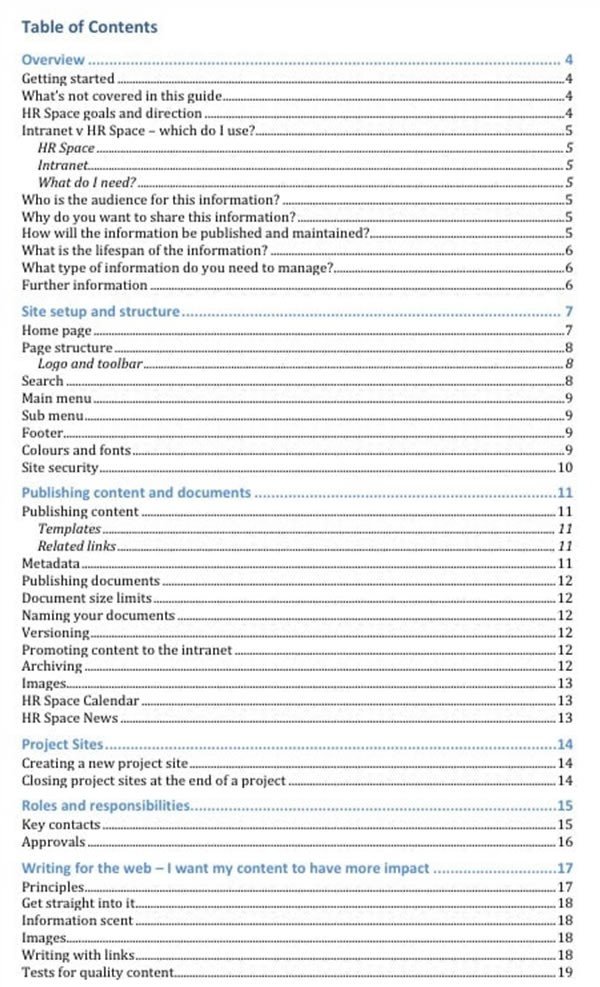
You can also find several intranet policy templates on the web to make your governance document easy to compile depending on your organization's needs and structure.
Intranet Guidelines For Employees
If you want your intranet to work without centralized governance in place, you need to put in some effort.
The secret is to keep all the employees on the same page about what is acceptable on the platform and what is not compliant. Though you can do this in several ways, the most effective way is to set clear intranet guidelines in a written format.
Intranet governance document available on the platform comes in handy. It can be concise and comprehensive and need not be too extensive.
Each organization has its own set of policies and guidelines concerning the use of the intranet. Some general topics include site design, site management, content oversight, security, branding, and user experience.
Planning Intranet Governance for AgilityPortal
When planning your new intranet in AgilityPortal, governance shouldn't be an afterthought — it should be built in from day one.
Your intranet is not just another tool.
It becomes the digital backbone of your organisation.
That means governance must align with your wider digital workplace strategy while also addressing the unique needs of an organisation-wide platform that impacts communication, collaboration, knowledge sharing, engagement, and compliance.
Start Governance Early — Not After Launch
Intranet governance planning should begin during the discovery and planning phase of your AgilityPortal rollout.
This ensures:
- Clear business objectives
- Shared stakeholder vision
- Defined success metrics
- Ownership across departments
Governance is not static. As your organisation grows, departments evolve, and new modules are enabled in AgilityPortal (CRM, Learning, Extranet, Analytics, Engagement tools, etc.), your governance framework must evolve with it.
If you skip this step early, you'll pay for it later with content chaos and low adoption.
Define Ownership or Expect Content Sprawl
A strong governance framework does three critical things:
- Defines priorities for what belongs on the intranet
- Prevents content duplication and outdated information
- Clearly assigns roles and responsibilities
One major difference between an intranet and other business systems is the number of contributors involved. Communications teams, HR, IT, department leads, project managers, and even frontline staff may all publish content.
If roles are unclear, the result is:
- Duplicate spaces
- Abandoned pages
- Inconsistent branding
- Outdated policies
- Low trust in the platform
In AgilityPortal, governance should clearly define:
- Who can create spaces
- Who approves organisation-wide announcements
- Who owns departmental content
- Who monitors engagement analytics
- Who reviews and archives outdated materials
Ideally, responsibilities are built into job descriptions or performance metrics — not treated as side tasks.
Governance Is More Than Policies
Many organisations make governance too theoretical.
Governance is not just a policy document.
It must include:
- User training plans
- Adoption and onboarding processes
- Content lifecycle rules
- Engagement monitoring
- Behaviour expectations
- Approval workflows
- Compliance oversight
In AgilityPortal, you have built-in analytics, engagement scoring, and usage tracking. Governance should define how that data is reviewed and what actions are taken when engagement drops or when spaces become inactive.
If nobody reviews analytics, governance becomes meaningless.
Combine Training and Governance
Creating a massive governance PDF that nobody reads is a waste of time.
Instead, build a central resource hub inside AgilityPortal that combines:
- "How to use" guidance (training)
- "How it should be used" expectations (governance)
- Short explainer videos
- Publishing standards
- Naming conventions
- Content approval rules
When users understand both the why and the how, adoption increases dramatically.
Governance works best when it is embedded into the platform experience — not stored in a forgotten folder.
Make Governance Operational
An effective governance plan should:
- Enable faster decision-making
- Clarify escalation paths
- Support compliance audits
- Reduce risk
- Improve content quality
- Protect brand consistency
And it must be reviewed regularly.
Quarterly governance reviews work well for most organisations. This ensures your structure, permissions, dashboards, and engagement strategy stay aligned with business priorities.
If you treat governance as a checkbox exercise, your intranet will drift.
If you treat governance as an operational discipline, your AgilityPortal deployment becomes a high-performing digital workplace asset.
Clear ownership. Clear expectations. Continuous review.
That's what keeps an intranet valuable instead of turning into a dumping ground.
Conclusion
There is no single perfect intranet governance; each organization is different and its governance policy differs from others.
Creating a governance document can take some time and effort but the right approach and best practices would make it easy. It is worth producing guides that result in a successful intranet and streamline the processes.
It will also keep your intranet content fresh, ensure a great user experience and establish consistency while reducing risks. Good intranet governance leads to a great intranet so organizations should consider spending some time to get it right.
Most Popular Posts

Effective communication among team members is vital for the productivity and success of any organization. Surprisingly, 60% of companies lack a long-term internal communication strategy, which p...


Businesses thrive on communication for efficiency, productivity and accomplishment. When the right information is passed from the right designation in the organization, it promotes positivity an...
Categories
Blog
(2798)
Business Management
(347)
Employee Engagement
(216)
Digital Transformation
(188)
Growth
(128)
Intranets
(125)
Remote Work
(62)
Sales
(49)
Collaboration
(44)
Culture
(29)
Project management
(29)
Customer Experience
(27)
Knowledge Management
(22)
Leadership
(20)
Comparisons
(9)
News
(1)

Related Posts

If you're searching for the best intranet software for large enterprises, chances are you're already feeling the pain — too many systems, too many logins, and not enough clarity. At scale, things get messy fast. You've got teams spread across l...

On the surface, hiring developers feels straightforward. You post a job, review a few CVs, compare rates, and get started. But in reality? That's where things usually start going wrong. Businesses don't fail because they can't find developers—t...

Featured
If you're searching for a SharePoint alternative, let's be honest — something's already not working. Maybe adoption is low. Maybe your team avoids it. Or maybe everything just feels… harder than it should be. You're not alone. In fact, research shows...

If you've been searching what is a proxy server or even just what is a proxy, you're definitely not alone. As more people worry about privacy, security, and control online, the demand for proxy servers is growing fast. In fact, research s...

Looking for a smarter way to manage your workforce scheduling? You're not alone. As businesses scale, the challenge of efficiently managing shifts, availability, and time-off requests becomes overwhelming—especially without the right tool...


Jill Romford
I am a digital nomad, lover of exploring new places and making friends.
I love to travel and I love the internet. I take pictures of my travels and share them on the internet using Instagram.
Traveler, entrepreneur, and community builder. I share my insights on digital marketing and social media while inspiring you to live your fullest life.
Ready to learn more? 👍
One platform to optimize, manage and track all of your teams. Your new digital workplace is a click away. 🚀
Free for 14 days, no credit card required.